
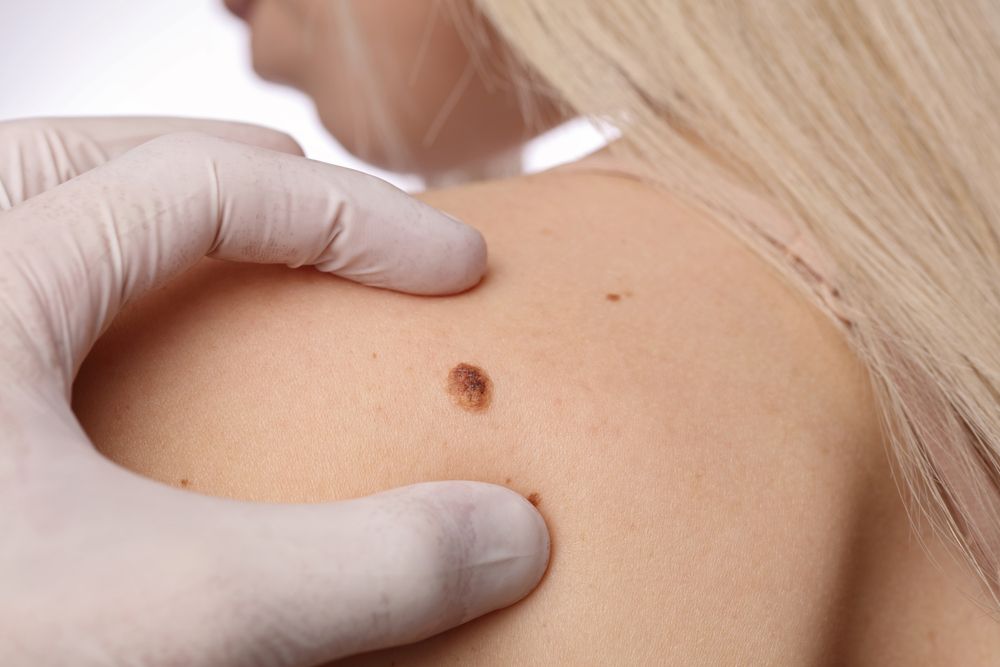
Moles
There are several skin lesions that are very common and benign (non-cancerous). These conditions include moles, freckles, skin tags, benign lentigines, and seborrheic keratoses.
The Importance of Getting Moles Checked
There are several skin lesions that are very common and benign (non-cancerous). These conditions include moles, freckles, skin tags, benign lentigines, and seborrheic keratoses.
Moles are growths on the skin that are usually brown or black. Moles can appear anywhere on the skin, alone or in groups.
Moles on the Body & Face
Most moles appear in early childhood and during the first 30 years of a person’s life. It is normal to have between 10-40 moles by adulthood.
As the years pass, moles usually change slowly, becoming raised and/or changing color. Often, hairs develop on the mole. Some moles may not change at all, while others may slowly disappear over time.
The vast majority of moles are not dangerous. The only moles that are of medical concern are those that look different than other existing moles or those that first appear after age 30. If you notice changes in a mole’s color, height, size, or shape, you should have a dermatologist (skin doctor) evaluate it. You also should have moles checked if they bleed, ooze, itch, or become tender or painful.
Examine your skin with a mirror or ask someone to help you. Pay special attention to areas of the skin that are often exposed to the sun, such as the hands, arms, chest, neck, face, and ears.
If a mole does not change over time, there is little reason for concern. If you see any signs of change in an existing mole, if you have a new mole, or if you want a mole to be removed for cosmetic reasons, talk to your dermatologist.
Causes of Moles
Moles occur when cells in the skin grow in a cluster instead of being spread throughout the skin. These cells are called melanocytes, and they make the pigment that gives skin its natural color. Moles may darken after exposure to the sun, during the teen years, and during pregnancy.
Don't wait. Schedule a mole check today, and be proactive about
the health of your skin.
Types of Moles
Congenital nevi are moles that appear at birth. Congenital nevi occur in about one in 100 people. These moles may be more likely to develop into melanoma (cancer) than are moles that appear after birth. A mole or freckle should be checked if it has a diameter of more than a pencil eraser or any characteristics of the ABCDEs of melanoma: (https://www.aad.org/public/spot-skin-cancer/learn-about-skin-cancer/detect/what-to-look-for).
Dysplastic nevi are moles that are larger than average (larger than a pencil eraser) and irregular in shape. They tend to have uneven color with dark brown centers and lighter, uneven edges. People with dysplastic nevi may have more than 100 moles and have a greater chance of developing melanoma, a serious form of skin cancer. Any changes in a mole should be checked by a dermatologist to evaluate for skin cancer.
Treatment for Moles
If a dermatologist believes a mole needs to be evaluated further or removed entirely, he or she will either remove the entire mole, or first take just a small tissue sample of the mole to examine thin sections of the tissue under a microscope (a biopsy). This is a simple procedure. (If the dermatologist thinks the mole might be cancerous, cutting through the mole will not cause the cancer to spread.)
If the mole is found to be cancerous, and only a small section of tissue was taken, the dermatologist will remove the entire mole by cutting out the entire mole and a rim of normal skin around it, and stitching the wound closed.